June 17, 2026 · by Amy
Posing for Maternity Photos, Made Simple
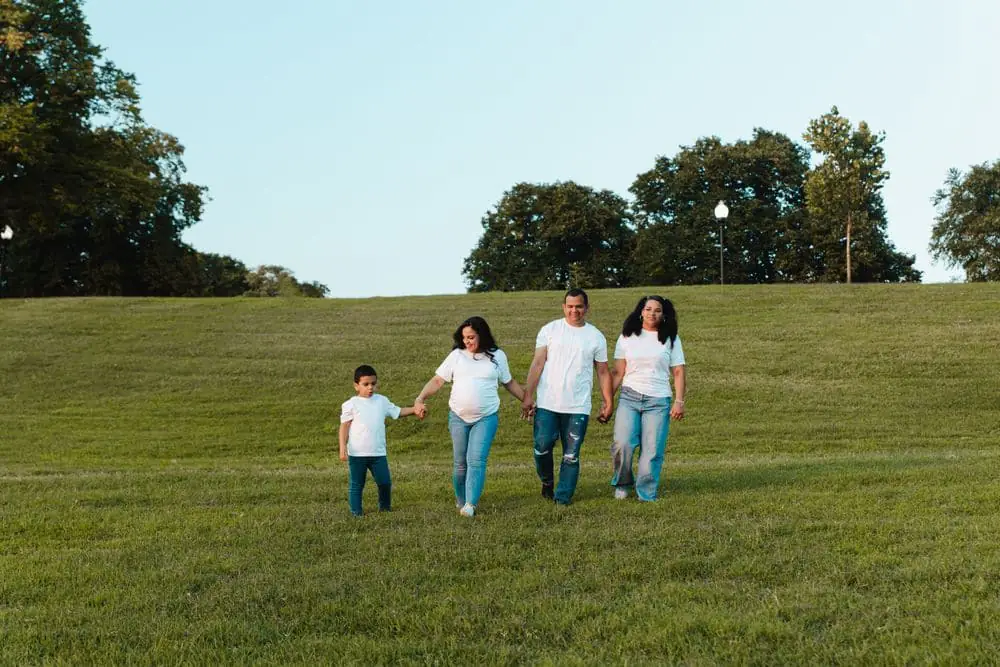
Posing for maternity photos comes down to four moves: turn to a slight profile so the bump reads, frame it with soft hands rather than gripping it, keep your weight on your back foot with a gentle arch, and breathe like a person instead of holding a pose. Everything else, the gown, the light, the location, builds on those four. And if your photographer directs sessions properly, you won’t need to memorize any of this; you’ll be posed in real time.
I shoot maternity sessions regularly, and it’s the work I started my career on. Most posing advice online is written for photographers. You’re the one being photographed, and you deserve the version that helps you walk in calm.
The five-second version
- Profile beats straight-on. A 45-to-90 degree turn is what makes the bump the subject
- Soft hands, top and bottom. Cradle lightly; a tight grip photographs as tension
- Back foot, gentle arch. Weight back, shoulders open, chin toward the light
- Movement is your friend. Walking, dress-swishing and laughing beat statue poses
- Partners and kids have jobs too. Forehead kisses, hand-holds and belly whispers all read as love
The four foundation poses
The profile cradle. Stand at a strong angle to the camera, one hand resting above the bump and one below, fingers relaxed. This is the maternity photo, the one that goes on the wall, and the relaxed fingers are what separate tender from clenched.
The look-down. Same stance, eyes down toward the bump instead of the lens. It reads as a private moment, and it’s the easiest pose in the set because nobody has to manage a camera face.
The walk. Holding a partner’s hand, or solo with the dress in one hand, walking slowly with real steps. Motion makes fabric move and shoulders drop, which is why walking frames feel effortless in every gallery.
The lean. Against a tree, a wall, a doorframe: leaning takes the effort out of standing and adds shape automatically. Late in pregnancy it’s also simply kinder to your feet, and the photos give away none of that.
Hands, the part everyone gets wrong
When people feel awkward, it shows up in their hands first. The fix is giving them one soft job each: one above the bump, one below, or one on the bump and one in a partner’s hand, or holding the dress, a hat, a sonogram print. Fingers stay long and loose; think resting, never gripping.
What to avoid is easy to remember: interlaced fingers over the belly photograph like a nervous knot, and flat palms pressed hard read as bracing. If you catch yourself squeezing, shake your hands out and let them land again. In my sessions I reset hands constantly, and it’s a two-second fix that upgrades every frame it touches.
You hold a pose for two seconds at a time. A good photographer rebuilds it with you between frames.
Angles, weight and the arch
Face the camera square-on and the bump disappears into your silhouette; turn side-on and it becomes the story. Most of a maternity session lives between those extremes, at the 45-degree mark where both your face and the bump photograph beautifully.
Put your weight on your back foot and let your front knee soften. Add a gentle arch, shoulders rolled back and down, and tip your chin slightly toward the light. It sounds like a lot to hold, and this is the honest secret of posing for maternity photos: you hold it for two seconds at a time, because a good photographer builds the stance with you between frames and keeps resetting it. You’re never performing all of it at once from memory.
One more that surprises people: sit down. Seated poses with legs angled and a hand on the bump are restful, flattering and underused, and they’re a gift in the third trimester.
What to wear, and why the gown works
Fitted beats flowy at the bump itself: fabric that skims the belly shows the shape you’re there to celebrate, while loose fabric hides it. The famous flowing maternity gowns get both, fitted through the bump with drama in the sleeves and train, which is why they’ve earned their place. Movement in the fabric also gives you something natural to do, and a train tossed mid-walk is the most reliable “wow” frame in the genre.
You don’t have to buy one for a single session. My clients can rent a gown from my collection for $60, in red, royal blue, light blue and pink across M through XL, or wear their own favorite. Solid colors photograph calmer than patterns, and whatever you choose, comfort wins: you’ll be moving, sitting and walking for an hour.

Partners, kids and the family version
A maternity session with a partner runs on connection poses: the behind-hug with hands meeting on the bump, forehead-to-forehead, the walking hand-hold, the kiss on the temple mid-laugh. None of them require modeling skill; they require looking at each other instead of the camera, and a photographer who prompts the moment rather than freezing you in it.
Kids make it a family session, and the trick is giving them a bump-related job: kissing it, whispering the baby a secret, or racing to hug mom first. The whispering shot wins in almost every gallery, partly because the child’s face does something no pose could script. If the kids wander mid-frame, that’s not a failure; some of the best maternity photos I’ve delivered have a toddler mid-orbit, because that’s what the family actually looks like.
Props and locations that help the poses
A few small props earn their place because they solve the hands problem while adding story: the sonogram print, a pair of tiny shoes, a letter board with the due date. One or two is plenty; the bump is the headline and props are seasoning. Skip anything you have to explain.
Location shapes the posing too. A park with open shade gives you the walking shots and room for kids to move. A backdrop session keeps everything controlled and makes the gown the whole show, and it travels to you. Golden hour outdoors is the classic for a reason, but a bright window at home can carry an entire session, robe and coffee cup included, if home is where you feel most yourself. Wherever you shoot, give yourself an unhurried hour; rushing is the one thing no pose can hide.
The 28-to-34 week window moves fast. Gown rental included if you want it.
Book your maternity sessionWhen to schedule the session
The sweet spot for most people is 28 to 34 weeks: the bump is unmistakably the subject, and energy is usually still good for an hour of moving around. Earlier works if you’re carrying multiples or simply feel best then; later can absolutely work too, with more seated and leaning poses in the mix. Book a few weeks ahead of your target window so the date lands where you want it, and if you’re renting a gown, mention it when you book so the color and size are reserved.
Three quick answers
What’s the most flattering pose for maternity photos? The most flattering maternity pose is the 45-degree profile cradle: turn your body at an angle to the camera, rest one hand above the bump and one below it, and look down. It flatters every body and every trimester.
Do I need to know how to pose before my session? With a directing photographer, you don’t. In my sessions the posing is my job; you arrive, I place you, and we adjust together frame by frame.
Can maternity photos include my whole family? Maternity photos can and should include your whole family for at least part of the session. Solo frames, partner frames and family frames each tell a different piece of the story, and one hour covers all three.
The part that matters more than any pose
The maternity photos people treasure aren’t the most technically posed; they’re the ones where you look like yourself, at ease inside a moment that only exists for a few months. Poses are just the scaffolding that gets a nervous person to that ease faster, and a directed session is the fastest version of that scaffolding you can book.
If you’re in Maryland, that’s exactly the session I run: gown options, full direction, and a plan built around your family. My maternity work lives on the Harford County photographer page, rates sit with the Baltimore photography prices, and the booking form takes it from a maybe to a date on the calendar.
Got a project behind this question?
Talk it through with Amy